




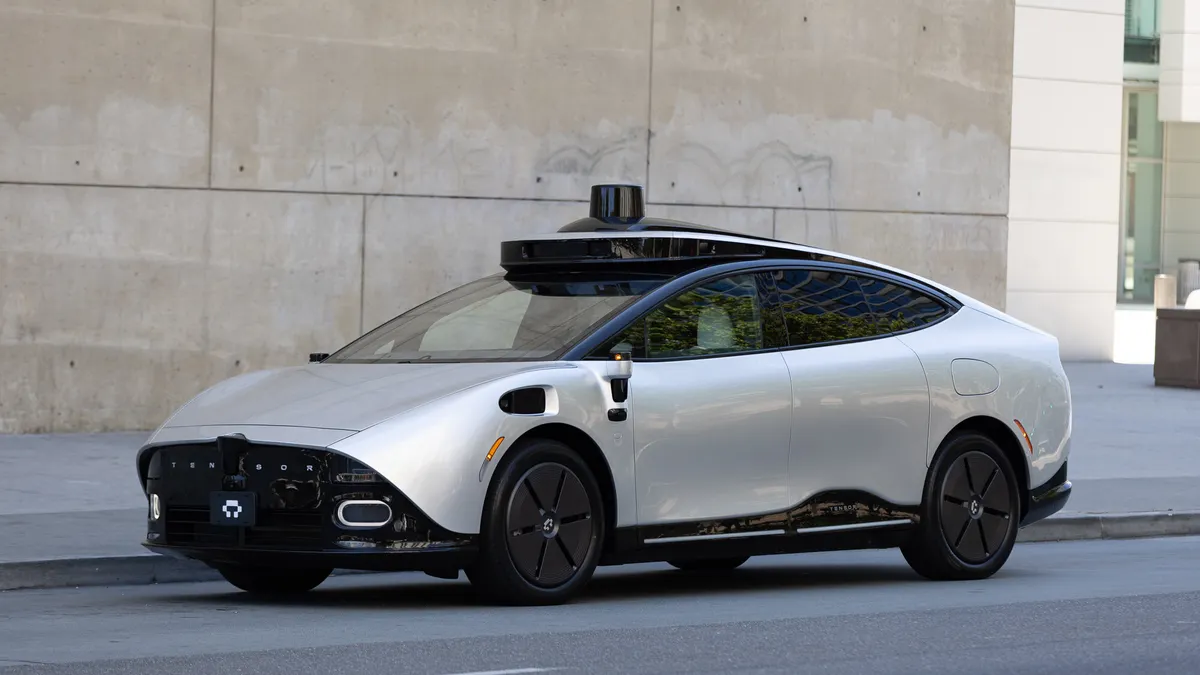
Silicon Valley startup Tensor has unveiled the RoboCar — the world’s first personal Level-4 autonomous EV, set to launch in 2026. Packed with AI, advanced sensors, and self-driving tech, it could redefine the future of mobility.
Introduction: A New Era of Personal Autonomy
The race toward fully autonomous vehicles has largely focused on ride-hailing fleets, but one Silicon Valley startup is taking a different approach. Tensor, in collaboration with Vietnamese automaker VinFast, has unveiled the Tensor RoboCar — a groundbreaking Level-4 self-driving EV designed not for fleets, but for personal ownership.
Set to debut in the second half of 2026, this vehicle promises to usher in a new era of AI-defined mobility, combining futuristic design, cutting-edge autonomy, and a bold vision of personalized robotaxis for everyday drivers.
The First Consumer-Focused RoboCar
Unlike competitors such as Waymo, Uber, and Tesla, which are deploying autonomous ride-hailing fleets, Tensor’s RoboCar is designed to be a privately owned vehicle.
Key Highlights:
- Launch Year: 2026 (H2)
- Autonomy: SAE Level-4 (self-driving without human intervention in supported areas)
- Global Markets: U.S., Europe, UAE (initial rollout)
- Production: VinFast plant in Vietnam (full assembly line integration)
By targeting consumers directly, Tensor becomes one of the first companies to bring Level-4 autonomy to personal garages rather than just commercial operators.
Futuristic Design and Features
The Tensor RoboCar combines advanced autonomy with driver flexibility.
- Foldable Steering Wheel & Retractable Pedals: First-of-its-kind feature allows seamless switch between autonomous and manual driving.
- Level-4 Autonomy: Full driverless operation in geo-fenced areas, with “assisted driving” available outside supported zones.
- Over 100 Sensors:
- 37 cameras
- 5 lidars
- 11 radars
- 22 microphones
- 10 ultrasonic sensors
- Collision, water-level, smoke, and tire-pressure detectors
- Triple-Channel 5G Connectivity: Always connected for real-time updates.
- Self-Cleaning Sensors: Protective covers and wipers prevent dust, pollen, or debris interference.
Inside, the vehicle offers panoramic displays, AI-driven infotainment, and full over-the-air (OTA) software updates, making it a truly software-defined car.
AI-Driven Autonomy: The Tensor Foundation Model
At the heart of RoboCar is the Tensor Foundation Model, a next-gen AI system built on transformer architecture — similar to the models powering advanced language AI.
Dual-System AI:
- Imitation Learning AI: Learns from expert driver data for instant decision-making.
- Multimodal Visual-Language Model (VLM): Trained on images, videos, and proprietary driving data to handle edge cases (such as unexpected roadblocks or confusing signage).
This approach allows RoboCar to mimic human cognition and learn complex patterns from its environment, making it one of the most adaptive AV systems in the industry.
Safety and Redundancy: Built for Trust
Safety remains the biggest challenge for autonomous cars, and Tensor is tackling it with redundant systems across all core functions:
- Drive-by-wire, brake-by-wire, and steer-by-wire
- Four-wheel steering for enhanced maneuverability
- Redundant power, communications, and control systems
Tensor claims this ensures fail-safe operation, even if one system fails.
Additionally, the company is partnering with Marsh, a global insurance broker, to launch the world’s first RoboCar insurance policy, ensuring owners are covered for autonomous operation risks.
Partnerships Powering the RoboCar
Tensor is working with an impressive list of Tier 1 suppliers and tech giants:
- Automotive: Bosch, ZF, Continental, Veoneer, Autoliv
- Semiconductors: Nvidia, AMD, NXP, Qualcomm, Samsung, Texas Instruments
- Manufacturing Partner: VinFast (Vietnam-based EV automaker)
This ecosystem approach gives Tensor a chance to scale quickly, leveraging proven suppliers while focusing on its AI autonomy stack.
Privacy and Data Security
Data privacy has been a major concern in connected vehicles, and Tensor has addressed it directly:
- Local Data Storage: All user preferences, location history, and personal data remain on the vehicle.
- Encrypted Access: Owners can retrieve data only via secure app or onboard systems.
- No Cloud Tracking: Minimizes risk of surveillance or hacking.
This positions RoboCar as one of the most privacy-conscious AVs in development.
Challenges Ahead
While the RoboCar promises revolutionary features, challenges remain:
- Regulation: Level-4 autonomy is still not legally permitted in many regions. U.S. states, European countries, and the UAE will need to expand legislation.
- Cost: Tensor has not revealed pricing, but given its tech stack and partnerships, it may debut as a premium vehicle before scaling down.
- Consumer Trust: Convincing customers to buy and rely on a personal robotaxi will require flawless performance and years of real-world validation.
Conclusion: A Bold Step Toward Autonomous Ownership
The Tensor RoboCar isn’t just another EV — it’s a blueprint for the future of personal autonomy. By combining advanced AI, over 100 sensors, and partnerships with leading suppliers, Tensor is betting on a world where owning a self-driving car is as normal as buying a smartphone.
If the 2026 launch goes as planned, Tensor could leapfrog established players like Tesla, Waymo, and Cruise, becoming the first company to put a personal Level-4 RoboCar in consumer hands.
The question now: will regulators, infrastructure, and drivers themselves be ready for the shift?